Journal spotlight · Mattana et al. · Cancer Treatment Reviews
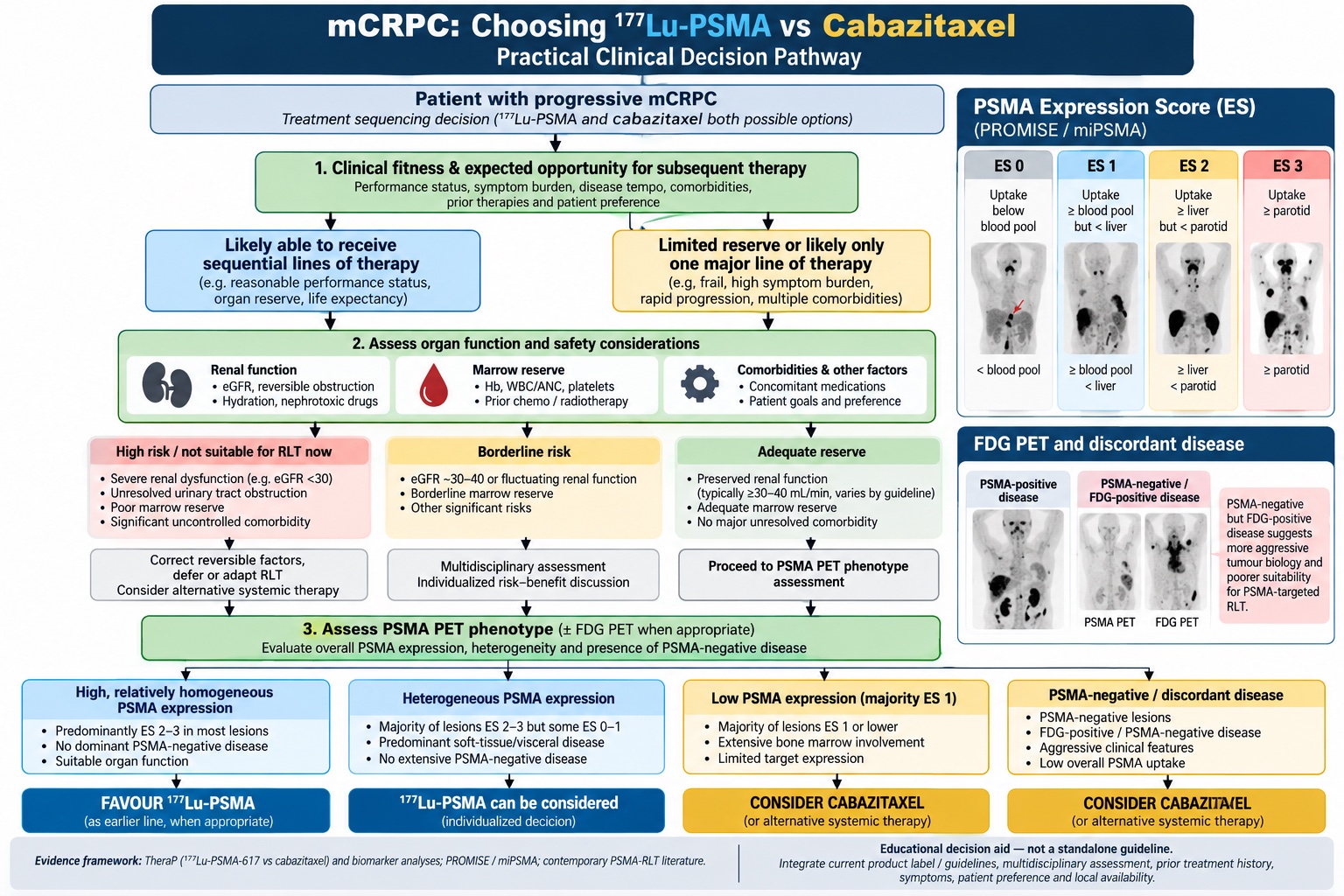
mCRPC: Choosing Lu-177 PSMA or Cabazitaxel
The decision depends on the patient's health and the cancer's imaging pattern.
Citation for this treatment pathway
Mattana F, Palesandro E, Dragonetti V, Curigliano G, Tucci M, Ceci F.
Optimizing the treatment pathway in post-docetaxel mCRPC: PSMA-RLT vs cabazitaxel. Cancer Treatment Reviews. 2026;150:103216. Published online 21 September 2026.
DOI: 10.1016/j.ctrv.2026.103216 · PMID: 42800445
The infographic is an original educational synthesis informed by this review and its evidence framework; it is not an original figure reproduced from the journal article.
What is this pathway about?
mCRPC means metastatic castration-resistant prostate cancer: cancer that has spread and is progressing despite testosterone being kept at a very low level. Lu-177 PSMA delivers radiation to cancer expressing the PSMA target. Cabazitaxel is a chemotherapy drug.
This infographic helps organise a discussion when both treatments are possible options. Its branches are a practical teaching framework; treatment eligibility and sequencing still require individual assessment.
How to follow the diagram
Start with the patient's overall condition
Consider daily activity, symptoms, how quickly the cancer is progressing, previous treatments and the patient's priorities. A fitter patient may have the opportunity to receive several treatments in sequence. Frailty or rapidly progressing disease may limit those opportunities.
Check kidney function and blood counts
Kidney function, urinary obstruction and bone-marrow reserve influence treatment safety. Blood counts help assess the ability to tolerate treatment. Reversible problems should be addressed, with specialist discussion when reserve is limited.
Look at PSMA uptake across the cancer sites
Strong, fairly consistent PSMA uptake supports consideration of PSMA-targeted therapy. Mixed uptake means some sites express the target more strongly than others. Significant low-uptake or PSMA-negative disease may need a different systemic approach.
Use FDG PET when it can answer an additional question
An FDG-positive but PSMA-negative lesion is active cancer without a clear PSMA target. This mismatch can signal disease that PSMA-targeted therapy may not adequately treat. FDG PET is useful in selected situations; it is not mandatory for every patient.
What do ES 0–3 mean?
The expression score compares tumour uptake with normal reference tissues on PSMA PET. Blood pool means activity in the blood; the parotid is a salivary gland near the ear.
| Score | Tumour uptake | Plain-language meaning |
|---|---|---|
| ES 0 | Below blood pool | Very little visible PSMA uptake |
| ES 1 | At least blood pool, below liver | Low uptake |
| ES 2 | At least liver, below parotid | Intermediate uptake |
| ES 3 | At least parotid | High uptake |
The score describes imaging; it does not prescribe treatment. The team also considers lesion size, distribution, tracer characteristics, disease outside the PSMA-positive sites and treatment-specific eligibility criteria.
Reading the treatment branches carefully
The infographic's “favour” and “consider” labels indicate topics for a clinical discussion. They do not guarantee a response or establish the best treatment order for every patient. Cabazitaxel also requires sufficient fitness and blood counts; poor marrow reserve does not automatically make chemotherapy safer.
Kidney thresholds in the diagram are simplified. The EANM/SNMMI guideline notes limited experience when GFR is 30–50 mL/min and recommends careful monitoring. Apply the current product information, local protocols and multidisciplinary judgement.
What does the supporting imaging review add?
Ranjan and colleagues review how imaging can support patient selection, response assessment and follow-up during Lu-177 PSMA therapy. PSMA PET/CT is central; FDG PET, post-treatment SPECT/CT and whole-body diffusion-weighted MRI can provide complementary information. Imaging findings should be interpreted alongside symptoms, blood tests and treatment history.
This is a critical review, rather than a new trial validating the supplied infographic. The authors also discuss imaging biomarkers and prediction models, while recognising the need for further validation.
For the direct treatment comparison, TheraP was a randomised phase II trial in selected patients. Lu-177 PSMA-617 produced more PSA responses than cabazitaxel, but longer follow-up found similar overall survival between the randomised groups. The diagram should therefore not be read as proof that one treatment always prolongs life more than the other.
Supporting imaging review and full PDF
Aditi Ranjan, Minal Padden-Modi, Hoda Abdel-Aty, Joao Galante, Simon Wan, Azzra Maricar, Adetokunbo Adesina, Brent Drake, Siraj Yusuf, Gary Cook, Nicholas James, Sola Adeleke.
The role of multimodality imaging in selection, response assessment, and follow-up of patients receiving 177Lutetium-PSMA-therapy. Insights into Imaging. 2026;17:13. Published 16 January 2026.
DOI: 10.1186/s13244-025-02151-x
Read the full 18-page paper on this page
If your browser does not show the document, use the Read full PDF button above.
The complete publisher PDF is reproduced unchanged under the Creative Commons Attribution 4.0 licence. © The Author(s) 2026. The explanation and supplied infographic are separate educational material.
- Mattana et al. · Treatment-pathway review on ScienceDirect
- Mattana et al. · DOI record
- Mattana et al. · PubMed record
- Ranjan et al. · Original open-access journal article
- Publisher's original PDF
- Ranjan et al. · PubMed record
- EANM/SNMMI · Lu-177 PSMA procedure guideline (2023)
- Hofman et al. · TheraP overall-survival follow-up (2024)