Prostate cancer theranostics · Malaysia
Lutetium-177 PSMA Therapy in Malaysia
Lu-177 PSMA is a targeted nuclear medicine treatment for selected patients with PSMA-expressing prostate cancer. It combines a PSMA-binding molecule with the beta-emitting radionuclide Lutetium-177, enabling radiation to be delivered to cancer sites throughout the body.
PSMA-targeted therapies · Evidence update
Why is TLX591 different?
The same target, a different delivery molecule.
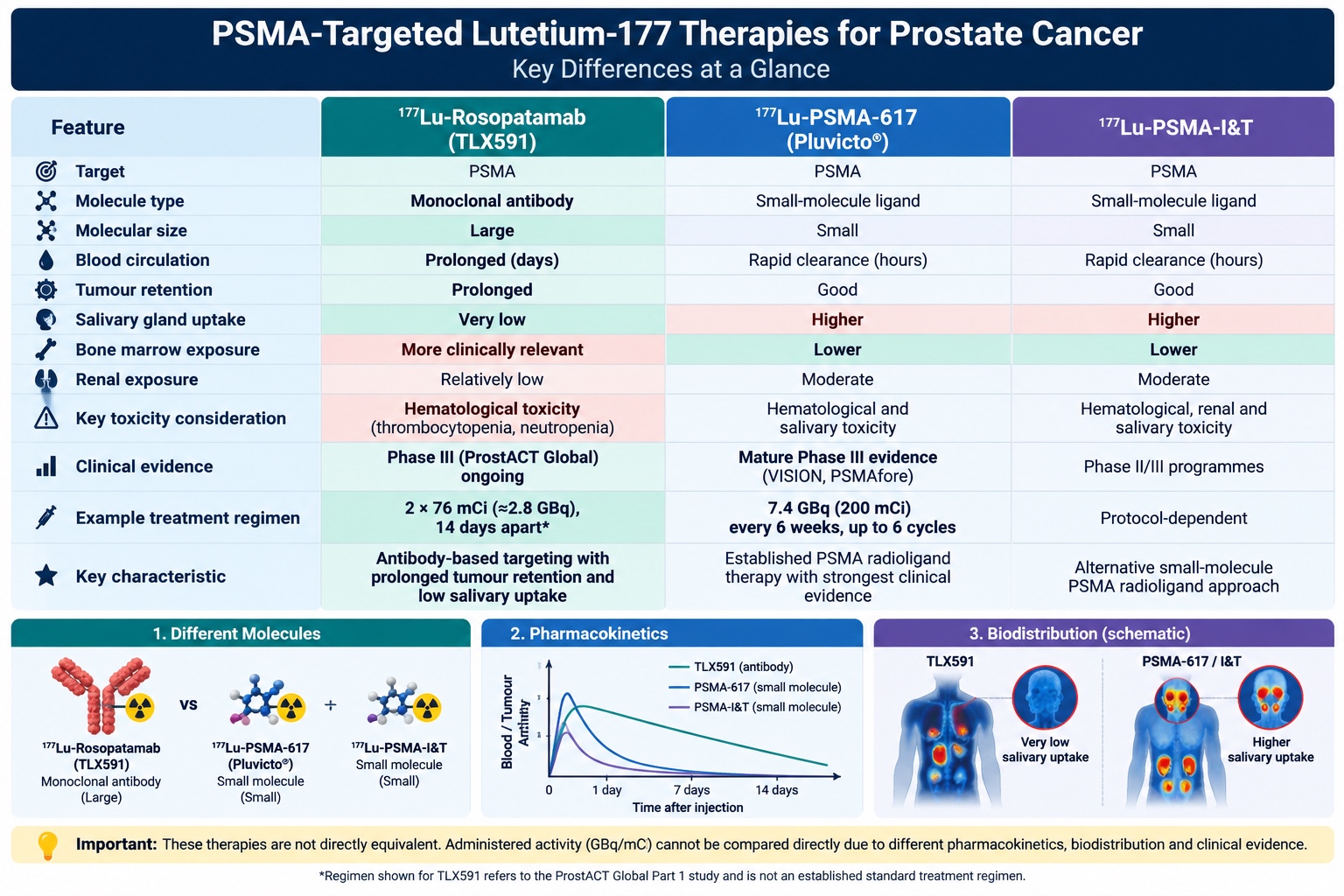
Unlike conventional small-molecule PSMA radioligand therapies, TLX591 (¹⁷⁷Lu-rosopatamab tetraxetan) uses a monoclonal antibody to target PSMA. Its prolonged circulation and tumour retention may allow sustained radiation delivery to PSMA-expressing cancer cells while producing very low salivary gland uptake.
Preliminary ProstACT Global data, however, demonstrate clinically significant haematological toxicity, particularly thrombocytopenia and neutropenia. Therefore, the potential advantages of prolonged tumour targeting must be considered alongside bone-marrow exposure.
What this means for patients
PSMA acts as the address on a cancer cell; the targeting molecule carries Lutetium-177 to that address. TLX591 uses a large antibody, while PSMA-617 and PSMA I&T use small molecules. Their different behaviour changes how long radiation remains in the tumour and which healthy tissues are exposed.
Low salivary uptake does not mean no dry mouth: dry mouth was reported in 25% of Part 1 patients. Small-molecule PSMA therapies can also cause clinically significant reductions in blood counts.
Bone-marrow safety matters
Sponsor-reported ProstACT Global Part 1 results included 36 patients receiving TLX591 with standard-of-care therapy.
| Event | Grade 3 | Grade 4 |
|---|---|---|
| Thrombocytopenia | 14% | 31% |
| Neutropenia | 22% | 25% |
Thrombocytopenia means low platelets, which can increase bleeding risk. Neutropenia means low neutrophils, which can increase infection risk. These small combination-treatment cohorts do not establish toxicity rates relative to other PSMA therapies.
Read the Part 1 resultsAdministered activity is not the same as absorbed radiation dose
These treatments should not be considered directly equivalent based on administered activity alone. Their pharmacokinetics, biodistribution, dosimetry and clinical evidence differ substantially. GBq or mCi describes the radioactivity administered; the absorbed dose to a tumour or organ depends on where it goes and how long it stays.
TLX591 remains under Phase III investigation, whereas ¹⁷⁷Lu-PSMA-617 has established randomised Phase III evidence, including VISION and PSMAfore. The available TLX591 data do not establish superiority to Pluvicto or PSMA I&T.
*Study regimen: the TLX591 regimen shown refers to ProstACT Global Part 1: two administrations of 76 mCi (approximately 2.8 GBq each), 14 days apart—approximately 5.6 GBq in total. It should not be interpreted as an established standard treatment regimen or converted into an equivalent Pluvicto dose.
Major regulatory update · 31 July 2026
Pluvicto moves earlier in metastatic prostate cancer
The US FDA has approved lutetium Lu 177 vipivotide tetraxetan (Pluvicto) in combination with an androgen receptor pathway inhibitor (ARPI) for adults with PSMA-positive metastatic androgen pathway modulation-naïve or-sensitive prostate cancer—previously referred to as metastatic hormone-sensitive prostate cancer.
Patients are selected using an approved PSMA PET product. The recommended regimen is 7.4 GBq every six weeks for six doses, or until disease progression or unacceptable toxicity.
Read the FDA announcement ↗[¹⁷⁷Lu]Lu-PSMA-617 in patients with PSMA-positive metastatic androgen pathway modulator-naïve/sensitive prostate cancer (PSMAddition)
Scott T Tagawa and colleagues
Adding Lu-177 PSMA-617 to ADT plus ARPI reduced the risk of radiographic progression or death by 28%. Grade 3 or higher adverse events occurred in 51% versus 43%; no unexpected safety signal was reported. Overall-survival data remained immature.
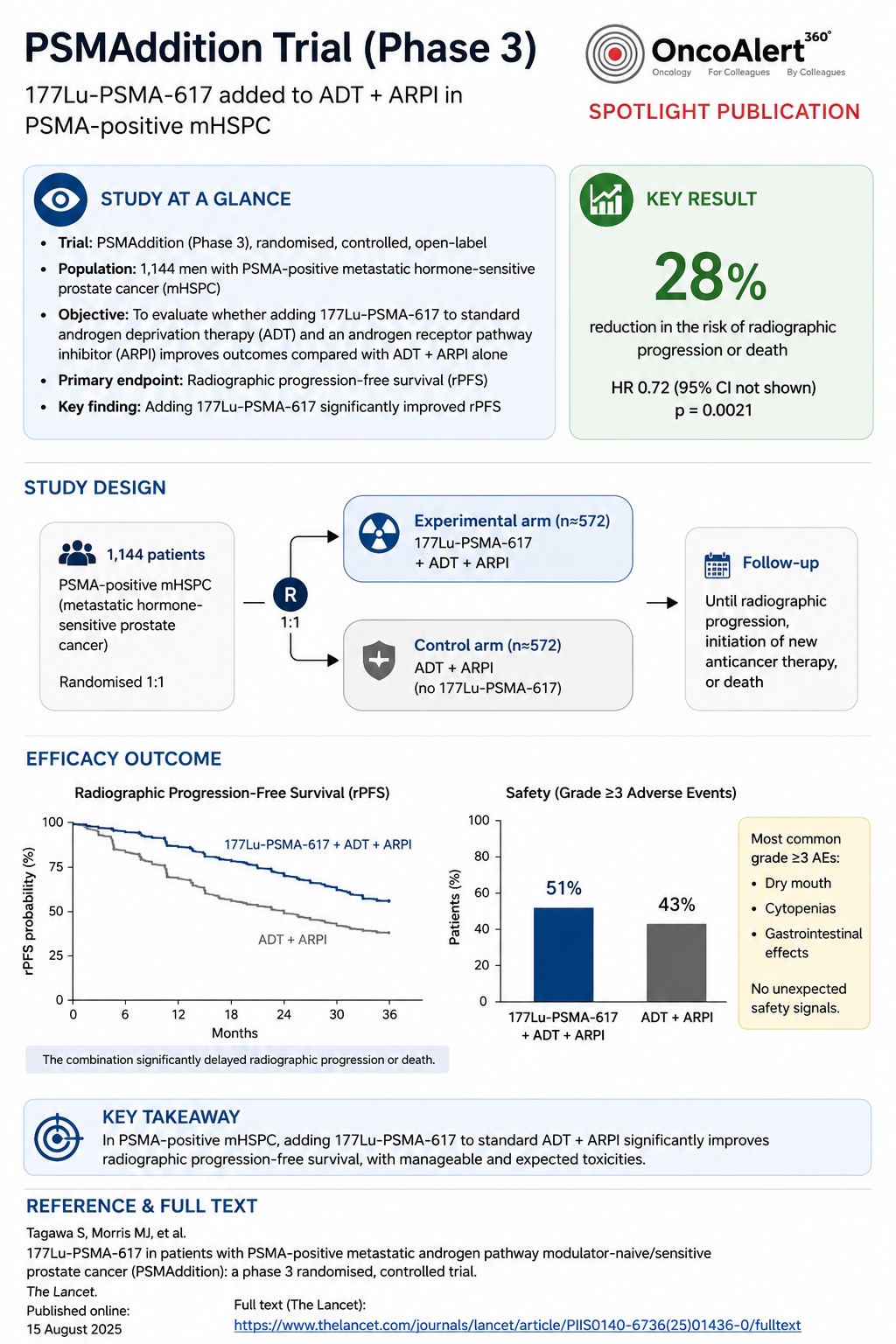
Verified reference update: the footer printed within the supplied diagram shows a 2025 reference that does not resolve to the PSMAddition paper. The verified Lancet article was published online on 6 August 2026.
Full text: https://www.thelancet.com/journals/lancet/article/PIIS0140-6736(26)01092-5/fulltextPSMA therapy evidence · Rechallenge
Lu-177 PSMA Rechallenge: the REALITY Study
Can Lu-177 PSMA-617 work again after an initial response and later progression? The REALITY registry analysis provides clinically relevant evidence for carefully selected patients with metastatic castration-resistant prostate cancer (mCRPC).
Efficacy and safety of rechallenge [¹⁷⁷Lu]Lu-PSMA-617 RLT after initial partial remission in patients with mCRPC
The analysis included patients who had achieved a biochemical response to their first Lu-177 PSMA-617 treatment series, maintained that benefit for a period, and then received treatment again after renewed progression.
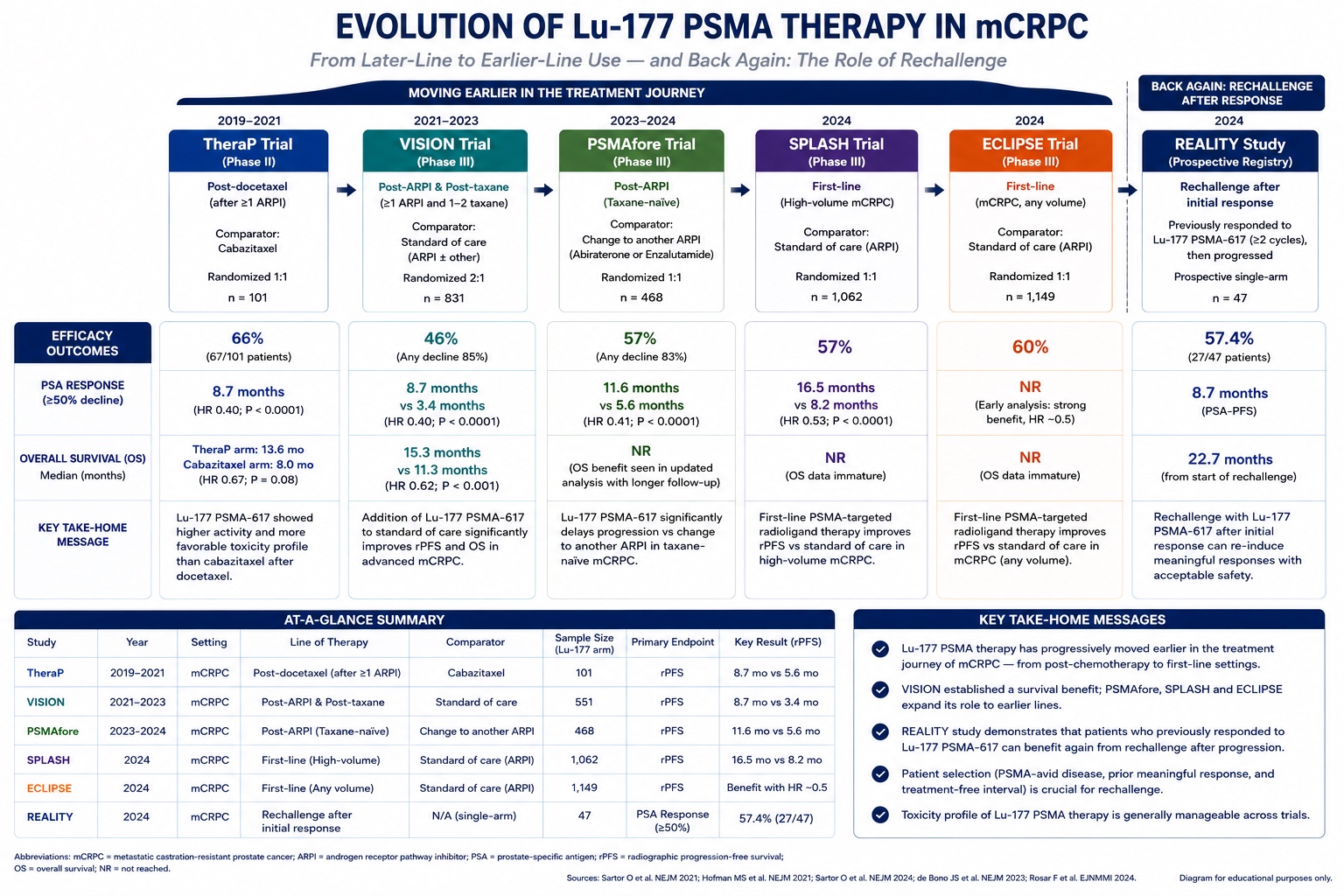
This educational overview combines studies with different designs, populations and endpoints; it is not a head-to-head comparison. Select the image to view it at full size.
A previous response can help identify patients who may benefit again.
After the first rechallenge series, 27 of 47 patients achieved a PSA reduction of at least 50%. No severe deterioration in the assessed adverse events was observed, supporting rechallenge as a potential option when disease remains PSMA-avid and the patient is otherwise suitable for further radioligand therapy.
Important context: this was a small, non-randomised registry analysis of highly selected previous responders, with individualised treatment activity and cycle numbers. The results should not be interpreted as evidence that every patient who progresses after Lu-177 PSMA should automatically receive rechallenge.
How targeted radioligand therapy works
PSMA is commonly overexpressed on prostate cancer cells. After intravenous administration, the radioligand travels through the bloodstream and binds to PSMA-expressing cells. Lutetium-177 then delivers short-range beta radiation to the tumour and nearby cells.
A PSMA PET scan is central to confirming that the disease demonstrates sufficient target expression. Treatment decisions also consider the clinical setting, previous therapies, bone-marrow reserve, kidney function and the patient’s overall condition.
What the PSMAddition result means
PSMAddition enrolled 1,144 patients and compared Lu-177 PSMA-617 plus ADT and an ARPI with ADT plus an ARPI alone. Radiographic progression-free survival improved significantly: hazard ratio 0.72 (95% CI 0.58–0.90; p=0.0021), equivalent to a 28% relative reduction in the risk of radiographic progression or death.
Grade 3 or higher adverse events occurred in 51% of the Lu-177 PSMA-617 group and 43% of the control group. The safety profile was consistent with prior experience, but longer follow-up is still required because overall-survival data were immature at the reported analysis.
This result represents PSMA radioligand therapy moving into an earlier metastatic, hormone-sensitive setting. It does not mean that every patient with metastatic prostate cancer should receive Pluvicto. PSMA PET selection, clinical eligibility, access and multidisciplinary sequencing remain essential.
What happens before and during treatment?
- Review by a multidisciplinary cancer team and nuclear medicine physician.
- PSMA PET imaging using an approved PSMA PET product.
- Blood tests including full blood count and kidney function.
- Pluvicto administered with an ARPI for the FDA-approved mAPMN/S indication.
- Hydration, radiation-safety guidance and scheduled follow-up.
Potential benefits and limitations
In appropriately selected patients, Lu-177 PSMA therapy may reduce tumour burden, lower PSA, improve symptoms and delay disease progression. Response varies and treatment does not guarantee cure.
Dr Zool Hilmi helped initiate Lu-177 PSMA therapy at Institut Kanser Negara in 2020 and later developed access at Thomson Hospital in 2023. Future availability at TLJCC remains subject to facility completion, licensing, regulatory approval and commissioning.
Side effects and monitoring
- Fatigue, nausea or reduced appetite.
- Dry mouth or salivary-gland symptoms.
- Temporary or clinically important reductions in blood counts.
- Kidney toxicity, radiation exposure and reproductive risks.
- Individual radiation-safety precautions after each administration.
Frequently asked questions
Questions patients often ask
How is TLX591 different from Pluvicto?
TLX591 uses a monoclonal antibody to target PSMA, while Pluvicto uses the small-molecule PSMA-617 ligand. TLX591 has prolonged circulation and tumour retention with very low salivary uptake, but clinically significant blood-count reductions have been reported. It remains investigational in Phase III; the available evidence does not establish superiority to Pluvicto.
Can TLX591 and Pluvicto be compared by their GBq or mCi alone?
No. Administered activity does not determine the absorbed dose to a tumour or organ by itself. Distribution and retention differ between antibodies and small molecules, so their treatment activities and schedules are not directly interchangeable.
Has the FDA approved Pluvicto for metastatic hormone-sensitive prostate cancer?
Yes. On 31 July 2026, the FDA approved Pluvicto with an androgen receptor pathway inhibitor for adults with PSMA-positive metastatic androgen pathway modulation-naïve or-sensitive prostate cancer, previously called metastatic hormone-sensitive prostate cancer.
What is Lu-177 PSMA therapy?
It is a targeted radioligand therapy in which Lutetium-177 is attached to a molecule that binds to PSMA on prostate cancer cells, delivering beta radiation to PSMA-expressing disease.
Who may be considered for treatment?
Suitability depends on the approved indication, PSMA PET findings, previous treatment, blood counts, kidney function and multidisciplinary specialist assessment.
How many cycles are given?
For the newly approved FDA indication, Pluvicto is given at 7.4 GBq every six weeks for six doses with an ARPI, or until disease progression or unacceptable toxicity.
What side effects can occur?
Possible effects include fatigue, nausea, dry mouth, reduced blood counts and kidney toxicity. Blood tests and clinical review are therefore required before and during treatment.
Clinical references
This patient information was prepared with reference to authoritative clinical and professional sources.
- ASCO 2026: ProstACT Global Part 1 safety and dosimetry (LBA5009)
- Telix: sponsor-reported ProstACT Global Part 1 results (2 June 2026)
- ProstACT Global clinical trial record: NCT06520345
- Telix: ProstACT Global Phase III development update (2 July 2026)
- FDA: Pluvicto evidence from VISION
- FDA: Pluvicto evidence from PSMAfore
- The Lancet full text: PSMAddition phase 3 randomised controlled trial
- DOI: 10.1016/S0140-6736(26)01092-5
- FDA approval announcement: Pluvicto with ARPI for mAPMN/S prostate cancer (31 July 2026)
- PubMed: PSMAddition trial record
- ClinicalTrials.gov: NCT04720157
- Joint EANM/SNMMI procedure guideline for 177Lu-PSMA therapy
- REALITY Study: Lu-177 PSMA-617 rechallenge after initial response
- PubMed: REALITY Study rechallenge analysis