Journal spotlight · I-131 therapy · Radiation safety
Radioiodine Spill–Induced Radiation Dermatitis
A case report highlighting why accidental liquid I-131 contamination should be reported immediately.
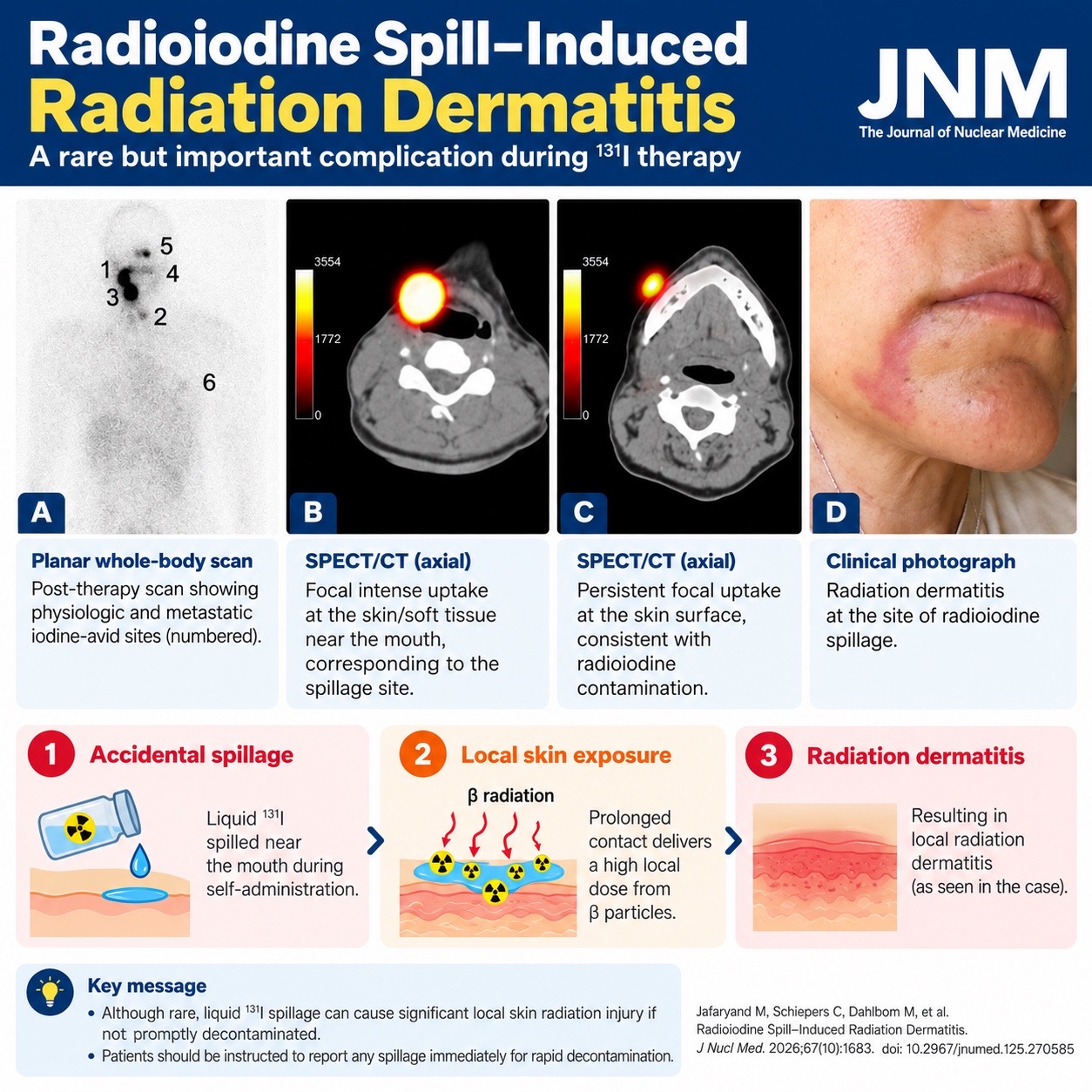
What happened in this case?
A 41-year-old woman with metastatic papillary thyroid carcinoma received liquid I-131 sodium iodide, 5.7 GBq (154 mCi), for remnant ablation. Some liquid spilled near her mouth during administration. She did not tell the treatment team and washed the area at home later that day.
On day 5, whole-body imaging and SPECT/CT were performed. The report describes radiation dermatitis at the spill site.
Why can a spill injure the skin?
I-131 emits beta radiation. Radioactive liquid remaining on skin can deliver a concentrated local dose, causing inflammation and skin injury. Prompt reporting allows the clinical team to check contamination and remove it sooner.
The 5.7 GBq figure is the administered treatment activity. It is not the amount spilled or the absorbed radiation dose to the skin.
How to read the images
- A · Whole-body scan
- Shows the distribution of iodine activity after therapy.
- B and C · Axial SPECT/CT
- Help localise the intense focus near the mouth to superficial tissues, supporting contamination at the spill site.
- D · Clinical photograph
- Shows the local skin reaction in the corresponding area.
Original journal and links
Radioiodine Spill–Induced Radiation Dermatitis. Journal of Nuclear Medicine. October 2026;67(10):1683. Published online 3 September 2026.