Research explained · Neuroendocrine tumours · ACTION-1
ACTION-1: A New Chapter After Lu-177?
When a treatment has helped, but the cancer starts growing again, the next question is simple: what could come next? ACTION-1 investigates a new radiation approach for selected patients with NETs.
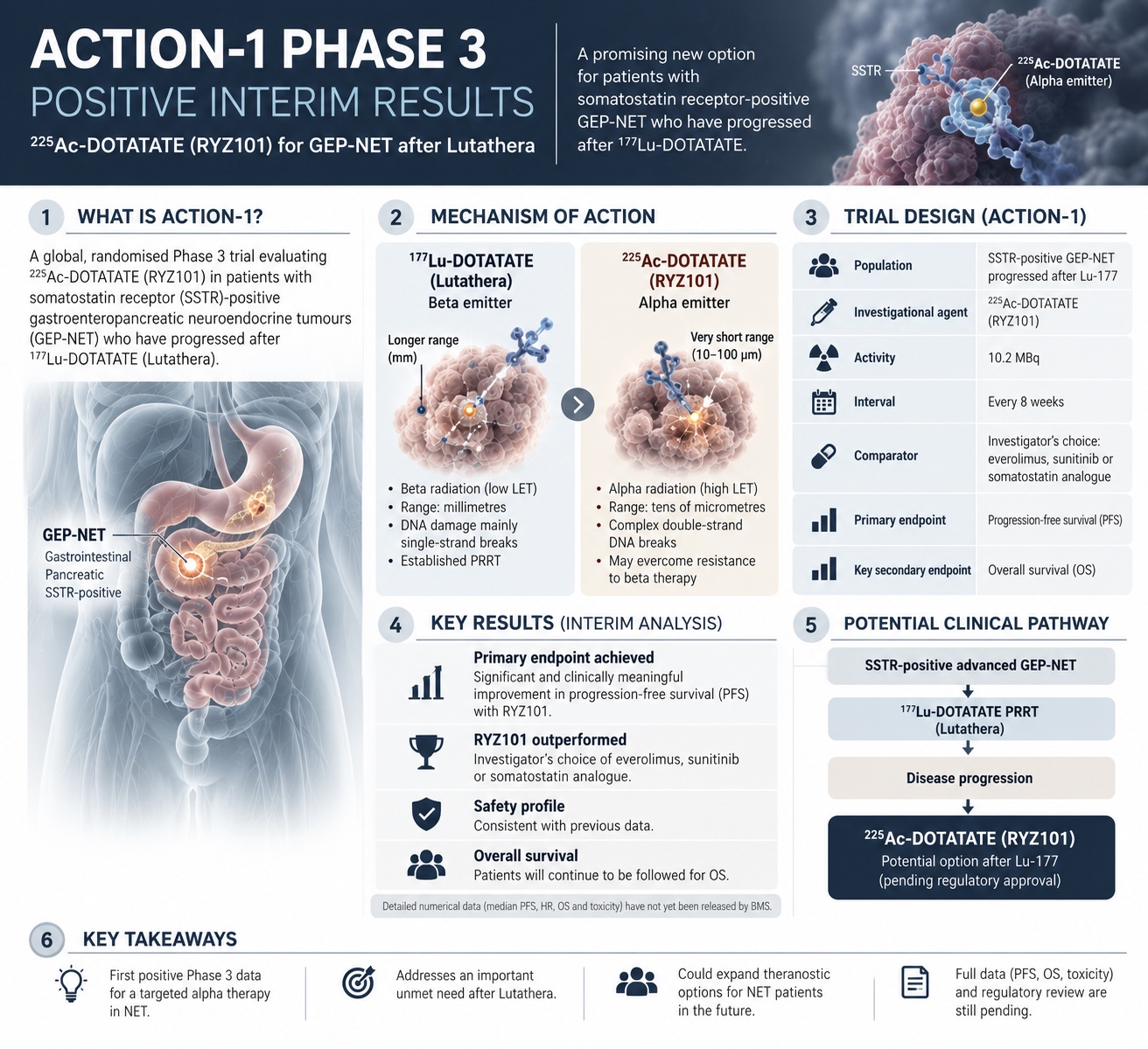
Start with one idea
Same address. Different radiation.
Imagine a tumour cell with a lock on its surface. That lock is the somatostatin receptor, particularly SSTR2. DOTATATE acts like a matching key, helping carry a radioactive substance to cells with this receptor. This is the targeting principle behind peptide receptor radionuclide therapy, or PRRT.
¹⁷⁷Lu-DOTATATE
DOTATATE + lutetium-177
A beta-emitting payload.
²²⁵Ac-DOTATATE
DOTATATE + actinium-225
An alpha-emitting payload: RYZ101.
The target remains familiar; the radiation changes. That is why researchers are testing whether an alpha approach can help after a Lu-177 treatment no longer controls the disease.
Follow the diagram, one panel at a time
What is ACTION-1?
GEP-NETs are neuroendocrine tumours arising in the digestive tract or pancreas. ACTION-1 studies adults with advanced, well-differentiated tumours that express somatostatin receptors and have progressed after a Lu-177-labelled treatment. SSTR PET helps identify the target. This is a selected study population, rather than every person with a NET.
The trial includes an earlier Phase 1b part and a randomised Phase 3 comparison. Randomisation helps make the treatment groups comparable. View the trial population and criteria ↗
Why change from beta to alpha?
Beta particles travel farther through tissue. Alpha particles travel only a few cell diameters, depositing energy much more densely along their short path. This density is called linear energy transfer (LET).
A useful comparison of the radiation in panel 2 Feature Lu-177: beta Ac-225: alpha Travel in tissue Submillimetre to millimetre scale Tens of micrometres Energy deposition Lower LET Higher LET DNA damage Can cause single- and double-strand breaks More densely clustered, complex damage The infographic simplifies DNA damage: beta radiation can also cause double-strand breaks. The important difference is how densely the damage is deposited. These physical differences provide a rationale for research; patient outcomes still need clinical evidence. Read the laboratory comparison ↗
How is the trial designed?
The Phase 3 part compares RYZ101 with the investigator's choice of everolimus, sunitinib, or higher-dose or more frequent long-acting somatostatin analogues. The published study design uses 10.2 MBq every eight weeks for four cycles.
MBq measures administered radioactivity. It does not measure the radiation energy absorbed by a tumour or organ, which is expressed in gray (Gy). Activity values for alpha and beta treatments cannot be compared as equivalent doses.
Study regimen, not a treatment instruction. Halperin et al., ASCO 2024 ↗
What do the positive results mean?
On 12 October 2026, BMS reported that the planned interim analysis met the main endpoint: improved progression-free survival (PFS) compared with the standard-care group, assessed by blinded independent review.
PFS: time alive before the disease worsens
The measurement ends when the cancer progresses or the patient dies. An improvement is encouraging, but does not by itself establish a cure or longer overall survival.
The sponsor also reported safety findings in line with previous experience. Detailed numbers, including median PFS, hazard ratio and adverse-event rates, were not provided in the announcement. Overall-survival follow-up continues. Read the primary announcement ↗
How should we read the possible pathway?
Panel 5 illustrates the research question: could Ac-225 DOTATATE become an option after progression on Lu-177? It is a potential future pathway. RYZ101 remains investigational, and the announcement describes plans for regulatory discussions.
Selection also depends on receptor expression, previous treatment, organ function and the pattern of disease. The arrow is not an automatic next step for every patient.
Why does this matter?
Patients need further options when a previously useful treatment stops controlling their cancer. ACTION-1 brings encouraging randomised evidence to that question. The next task is to examine how large and durable the benefit is, alongside safety, when the full results are presented.
Three questions readers often ask
Does better PFS mean patients live longer?
PFS and overall survival answer different questions. PFS counts time until progression or death; overall survival counts time until death from any cause. This announcement does not establish an overall-survival benefit.
Does this show alpha is always better than beta?
ACTION-1 studies alpha treatment after progression on Lu-177, compared with selected standard therapies. It is not a direct comparison of RYZ101 and Lu-177 DOTATATE as the first PRRT.
Can patients receive RYZ101 routinely now?
It remains investigational as of this update. Positive interim results do not establish approval or availability in Malaysia. Access depends on the applicable research and regulatory pathway.
Go straight to the original sources
The October 2026 news is a sponsor announcement. A full Phase 3 publication and detailed results were not provided with it. The earlier ASCO abstract below describes Phase 1b findings and the Phase 3 regimen; those are different stages of evidence.
- Bristol Myers Squibb / RayzeBio. ACTION-1 Phase 3 interim announcement, 12 October 2026. Official BMS source ↗
- ACTION-1 · NCT05477576. ClinicalTrials.gov ↗ · UCSF trial criteria ↗
- Halperin DM, Morris M, Ulaner GA, et al. ACTION-1 Phase Ib safety and efficacy findings. Journal of Clinical Oncology. 2024;42(16_suppl):3091. ASCO meeting abstract, published online 29 May 2024. Original journal abstract ↗ · DOI: 10.1200/JCO.2024.42.16_suppl.3091 ↗
- Graf F, Fahrer J, Maus S, et al. Laboratory study of DNA double-strand damage with Ac-225 and Lu-177 somatostatin-receptor-targeted radiation. PLOS ONE. 2014;9(2):e88239. Published 7 February 2014. Preclinical evidence explaining the physics; separate from the ACTION-1 clinical results. Original study / DOI ↗